Data Collection and Analysis for Social Impact Organizations
We partner with social impact organizations, coalitions, and philanthropic institutions to design and execute mixed-methods research that provides the nuanced insights needed to achieve operational and strategic goals. Our work is grounded in participatory principles and a deep respect for community knowledge.
Survey Development: We develop surveys that accurately capture the data you need to answer key questions for your organization. We work collaboratively with your staff and partners to create surveys that are culturally sensitive, translated into the appropriate languages, and ask the right questions to get the insights needed for your work. We have designed surveys for thousands of respondents on topics ranging from voter barriers to network health.
Focus Group Facilitation: We develop questions and notetaking guides to capture qualitative data from focus groups that will identify nuanced findings to support your organization's mission. We work directly with organizers to develop questions that will uncover the "why" behind quantitative findings, helping you understand the lived experiences and perspectives of your constituents.
Data Analysis and Reporting: We analyze the data collected from surveys or focus groups using a range of methods, from statistical analysis to advanced social network analysis. We draw insights that impact your organization's operational or strategic goals and translate these insights into actionable next steps. We present our findings to your constituents, decision-makers, funders, or board members in the format that works best for you—whether a presentation, an interactive dashboard, or a written report.
Social Network Analysis: We conduct network analyses to measure the health and connectedness of coalitions and networks. We calculate metrics like network density, centrality, and connectivity, and we develop network visualizations to translate complex relational data into a clear, visual tool you can use for strategic planning.

This case study illustrates how Rooted Solutions partners with organizations to collect, synthesize and interpret data to inform their strategic decision-making. While the scenario presented here is fictional to protect client confidentiality, every service, workflow, and analytical approach described is based on work Rooted Solutions has successfully performed with past clients.
Case Study: Strengthening Cross-Network Collaboration through Survey Design and Network Analysis
Sample Scenario:
Progress for All (P4A), a national coalition of progressive organizations consists of members across four issue areas: Housing Justice, Environmental Justice, Healthcare Justice, and Economic Justice. P4A wanted to understand whether their investment in relationship-building, collaborative funding and convenings were strengthening cross-network collaboration and fostering a greater sense of belonging across movements. P4A partnered with Rooted Solutions to design and analyze a coalition-wide network survey.
This work sample is based on an actual consulting engagement. To protect client confidentiality, organization names, movement names, and other identifying details have been anonymized, while the underlying analysis methodology, and deliverables remain substantially unchanged.
-
Progress for All understood that, in general, they wanted to get a better understanding of their coalition’s solidarity and interconnectedness. However, they did not already have specific questions they wanted to answer from the analysis. Jamal, the Rooted Solutions consultant working on this project, worked with them to clarify this. To do this, he interviewed Progress for All Staff and several key coalition members from each of the four movement areas to understand what types of insights would be most useful to gain from the analysis. Through iterative collaboration, they landed on three core questions:
1. How connected are coalition members to each other, within their primary movement?
2. How connected are coalition members to movements outside of their primary movement?
3. What factors indicate an increase in a coalition member’s feeling of belonging to other movements?
-
Rooted Solutions designed a mixed-methods survey to measure network health. Working closely with coalition leadership, survey questions were developed to measure relationship strength, trust, frequency of collaboration, knowledge sharing, and collective problem solving.
First, with the support of Mississippi Together table members, Rooted Solutions organized a series of Focus Groups with voters within each of the target areas that matched the researched demographics. Jamal worked directly with the organizers in each of the areas to develop questions that would provide the qualitative data needed to understand why the findings in the Landscape analysis were occurring.
After conducting the focus group sessions and analyzing the data, Rooted Solutions found that there were two major contributors to low turnout within the named demographics.
Rural Transportation: Voters without cars in 7 specific rural counties had a difficult time getting to the polls to vote.
Urban Childcare: Low-income urban voters had difficulty accessing the childcare they need to wait in potentially long voter lines.
Services Provided:
Focus Group Design and Facilitation
Qualitative Research
Community Engagement Strategy
Qualitative Data Analysis
-
First, Jamal performed an exploratory analysis of the received survey data. Some of the factors he considered were the number of individual activists vs organizations in the coalition, the distribution of coalition members across the core movement areas and geographical location, and the average and distribution of belonging and understanding scores across movements.
-
After completing the Exploratory Analysis, it was clear that the most appropriate analytical approach to understand the connectedness within and across movements would be by conducting a network analysis. Therefore, Jamal calculated metrics such as network density, centrality, and connectivity between coalition members and developed a series of network visualizations to translate this complex relational data into a visual tool that P4A could use. This analysis was developed at both at the organization level as well as at the movement level.
Our Approach
Our Results
Notes:
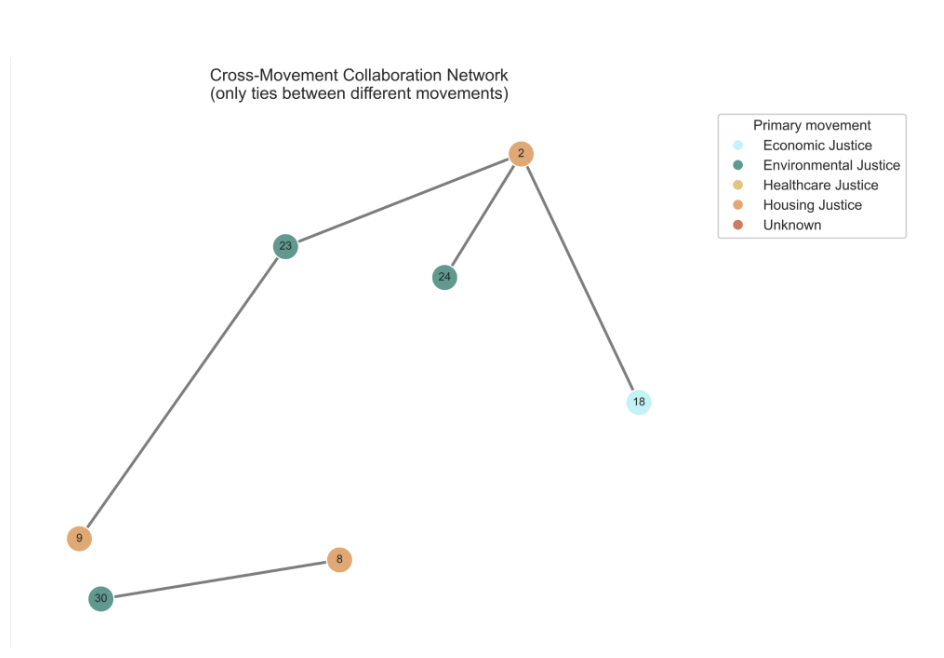
Each node represents a different collective member by ID number.
The larger the node size, the more connections that the collective member has with other members.
The color of the node is determined by the collective member’s primary movement.
Shaded regions indicate clusters of organizations that share the same primary movement.
The edge strength is determined by the number of collaborations between members and the strength of those collaborations, as indicated in the survey data. Weak strength is shown with a dashed line, medium strength edges have a light gray solid line, and strong edges have a dark gray solid line.
Strategic Learnings
-
Where connections exist, the vast majority (90%) occur within the same primary movement.
Within most primary movements, coalition members tend to be very connected to one another. For example, in the Housing Justice movement, we see a fully connected, unified network structure. Both Economic Justice and Environmental Justice were nearly fully connected, with only one fracture in the network each.
Interestingly, this movement connectedness did not translate into coalition members feeling as though resources and opportunities within their movements are shared equitably. The Movement Sharing score was very similar across all movements, each ranging between 2.6/5 – 2.8/5. This might be an area for further research.
-
Inter-movement connectedness was much lower than intra-movement connectedness.
Across movements, nearly half (45%) of respondents reported “Not at All” when asked if they felt a sense of belonging in other movements. However, 58% of respondents indicated that they saw their movement as being connected to other movements.
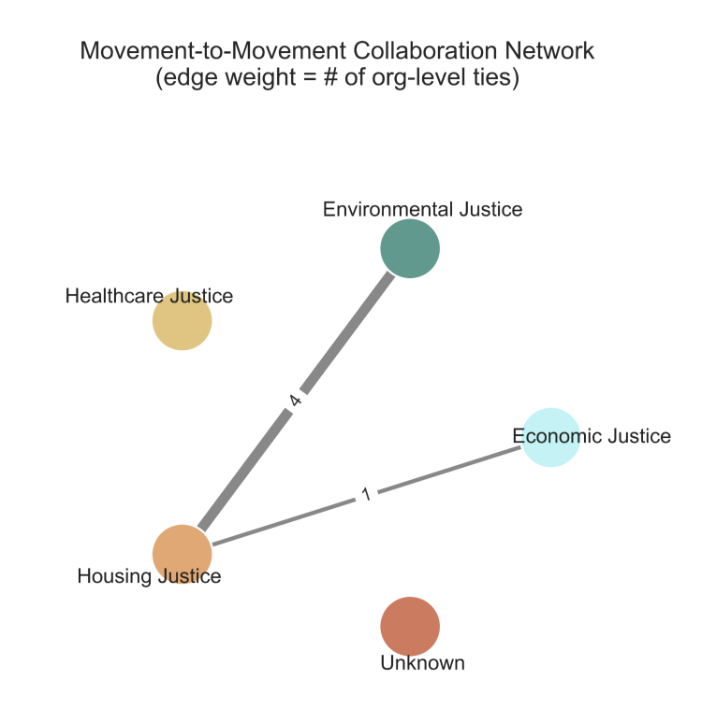
Another interesting finding was that the three movements with more intra-connections also felt their movement was more inter-connected with other movements. Their movements’ synergy scores – Environmental Justice (3.6/5), Housing Justice (3.2/5), and Economic Justice (3.3) – were higher than that for Healthcare Justice (2.9). This translated to practiced solidarity between movements, where Housing Justice, Environmental Justice, and Economic Justice were the only movements that collaborated across movements. This phenomenon – increased connection within a movement translating to greater connection across movements – is one that could be explored further in future research.
Nonetheless, there are generally much fewer inter-movement connections than intra-movement connections. In total, only seven coalition members collaborated with movements outside of their own. At a movement level, the strongest cross-movement ties (4) are between the movement for Environmental Justice and the movement for Housing Justice. Additionally, there was one cross-movement tie between Economic Justice and Housing Justice. No other cross-movement connections were reported.
First, with the support of Mississippi Together table members, Rooted Solutions organized a series of Focus Groups with voters within each of the target areas that matched the researched demographics. Jamal worked directly with the organizers in each of the areas to develop questions that would provide the qualitative data needed to understand why the findings in the Landscape analysis were occurring.
After conducting the focus group sessions and analyzing the data, Rooted Solutions found that there were two major contributors to low turnout within the named demographics.
Rural Transportation: Voters without cars in 7 specific rural counties had a difficult time getting to the polls to vote.
Urban Childcare: Low-income urban voters had difficulty accessing the childcare they need to wait in potentially long voter lines.
Services Provided:
Focus Group Design and Facilitation
Qualitative Research
Community Engagement Strategy
Qualitative Data Analysis
-
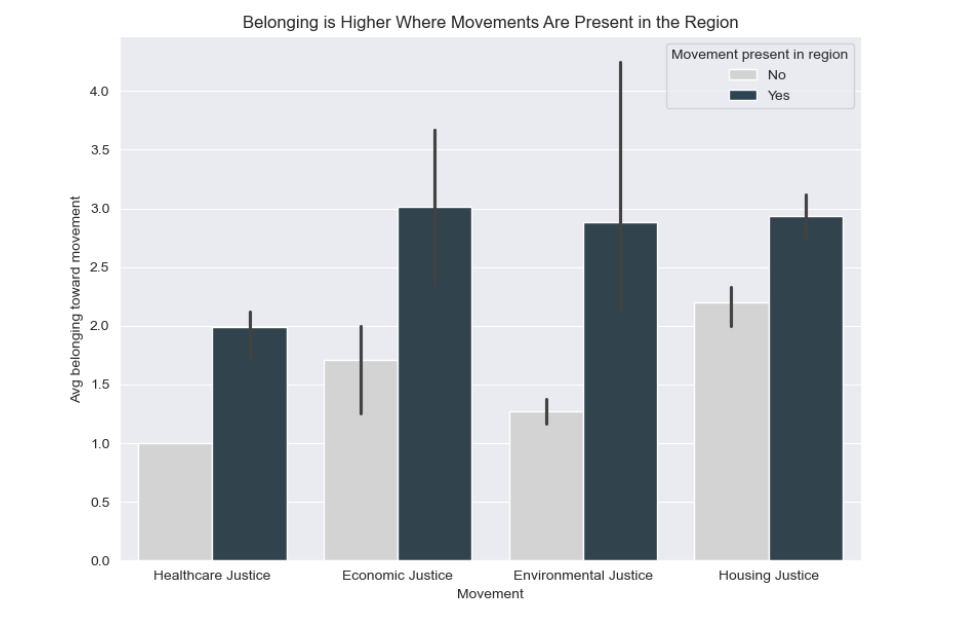
The more proximity (geographical or direct connection) a coalition member had to coalition members in other movements, the higher their belonging score for that other movement.
Belonging was consistently higher when (1) a movement had at least one member present in the respondent’s region (Figure 4.2 shows this as a visual representation) and (2) the respondent’s organization had collaborated with at least one organization in that movement. On average, members with cross-movement collaborations reported a belonging score of 3.0, compared to 1.6 for those without collaborations. These findings suggest that relational proximity, geographic or collaborative, is strongly associated with narrative and emotional proximity.
Furthermore, movement-wide, belonging towards a movement increased as coalition members collaborated more with other coalition members within that movement (Spearman ⍴ = 0.295). This positive correlation also held at the individual movement level. Across movements the rank-correlation is as follows: Housing Justice – 0.115, Economic Justice – 0.315, Environmental Justice – 0.497. This is extremely important for cross-movement solidarity. These findings support P4A’s strategic emphasis on narrative power and relational infrastructure because belonging appears to grow through contact, collaboration and regional proximity.
Recommendations and Next Steps
The analysis identified several opportunities for strengthening cross-movement collaboration, while providing empirical support for the coalition’s existing investment in relationship-building. In particular, the findings show that increased collaboration across movements are likely to translate into an increased sense of belonging across movements, with the objective of increasing solidarity.
Furthermore, there are two key next steps that can be taken from this analysis:
The data shows that increased interaction between coalition members from different movements increased their feeling of belonging in other movements. Examine whether different types of interactions (e.g., joint campaigns, shared political education, solidarity-building convenings, etc.) produce different belonging outcomes. Understanding the relational mechanisms behind belonging will help P4A design more effective cross-movement engagements.
Movements that were more connected internally were more connected externally. Further explore whether internal cohesion within movements strengthens their ability to build principled cross-movement relationships.